
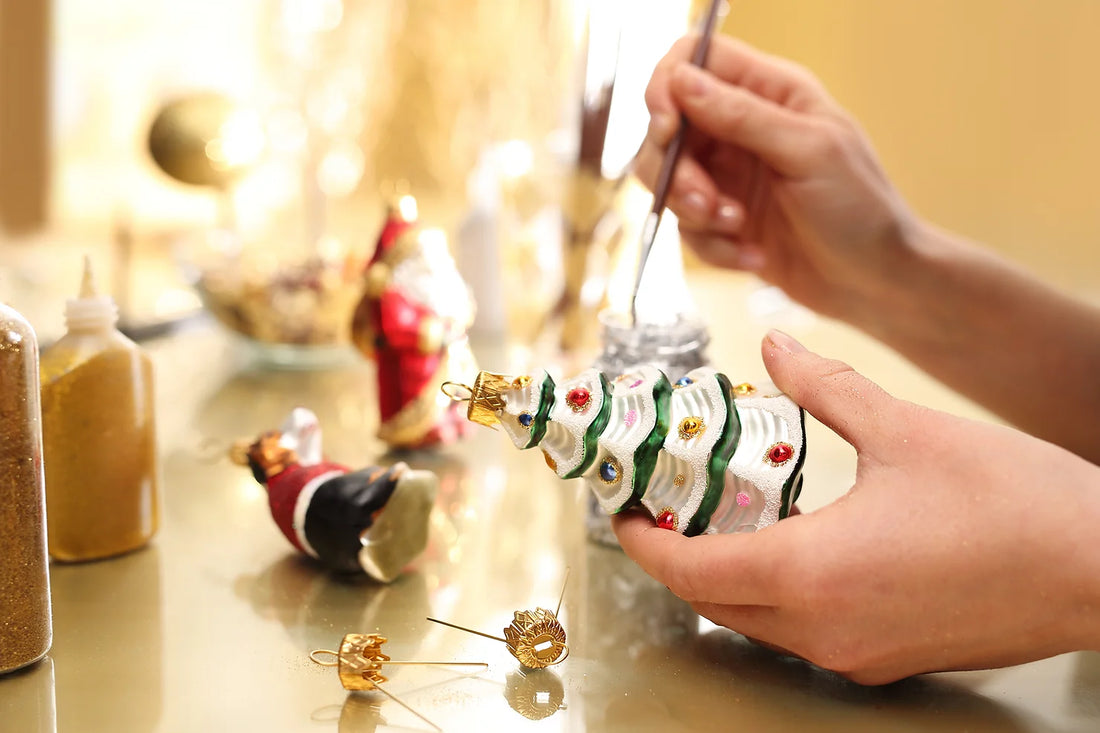
How Glass Christmas Ornaments Are Made, Step by Step
Every glass ornament we sell is made by hand, mostly in small family workshops in the Czech Republic and Poland. Each one passes through several pairs of hands before it reaches your tree. Here's how it's done.
1. Blowing the glass
A glassblower heats a clear glass tube over a gas flame until it softens, then blows into it. Round baubles are free-blown, shaped only by breath and a steady turning of the tube. Figures such as mushrooms, pickles and animals are blown into a mould, so the glass takes on its shape from the inside out.
2. Silvering
Once the glass has cooled, a silver nitrate solution is swirled inside. It leaves a wafer-thin mirror on the inner wall, which is what makes the colours glow. The method was developed by the German chemist Justus von Liebig in the mid-1800s; before that, ornaments were lined with lead or tin.
3. Colour
Next, the ornament is dipped in coloured lacquer and hung upside down to dry. Because the silver mirror sits underneath, a red bauble isn't just red: it shines from within.
4. Hand painting

Then comes the part that makes every ornament unique. Painters add the details by hand with fine brushes: faces, flowers, snow, a dusting of glitter. No two pieces are ever quite the same, which is how you can tell a hand-painted ornament from a printed one.
5. Other techniques
Some ornaments get extra treatment. Reflector (indent) baubles are pressed inwards while the glass is still hot, creating a dimple that catches the light; see our reflector baubles. Acid etching is less common: acid is used to frost part of the surface, leaving a matte pattern against the shiny glass.
Decoupage takes a different route to a picture. Instead of painting the scene, a printed picture is cut out, laid onto the glass so it follows the curve, and sealed under varnish. The edges are then hidden by hand with glitter, snow or paint, so the picture looks part of the ornament. It is a centuries-old craft that began on furniture in 17th-century France and became a fashion in 18th-century Venice, and it gives a level of fine detail that would take a painter hours. Read more in What Is Decoupage?
6. Capping and packing
Finally, each ornament gets its metal cap and hook, and is wrapped and boxed, ready to give as a gift or to store from one Christmas to the next.

Where the craft began
Glassblowing in Lauscha, Germany, dates back to the 1590s, and its workshops made the first glass baubles in the mid-1800s. The craft spread through Bohemia and Poland, where family workshops still pass their skills down the generations. In 2023, handmade glassmaking was added to UNESCO's list of intangible cultural heritage. Read what that recognition means, or browse our hand-painted baubles.
Updated November 2026